Reading Manipulatives in an Upper Elementary Classroom
"Must Have" Math Manipulatives for Upper Uncomplicated
Today I'k sharing my love of math manipulatives with yous. Having a variety of manipulatives for math "at the ready" in my fourth grade and 5th grade classroom is critical for inspiring ideas for hands-on math games and activities. Different manipulatives requite me the opportunity to design games and lessons at unlike levels for scaffolding and differentiation that helps students build on their understanding of a math concept.
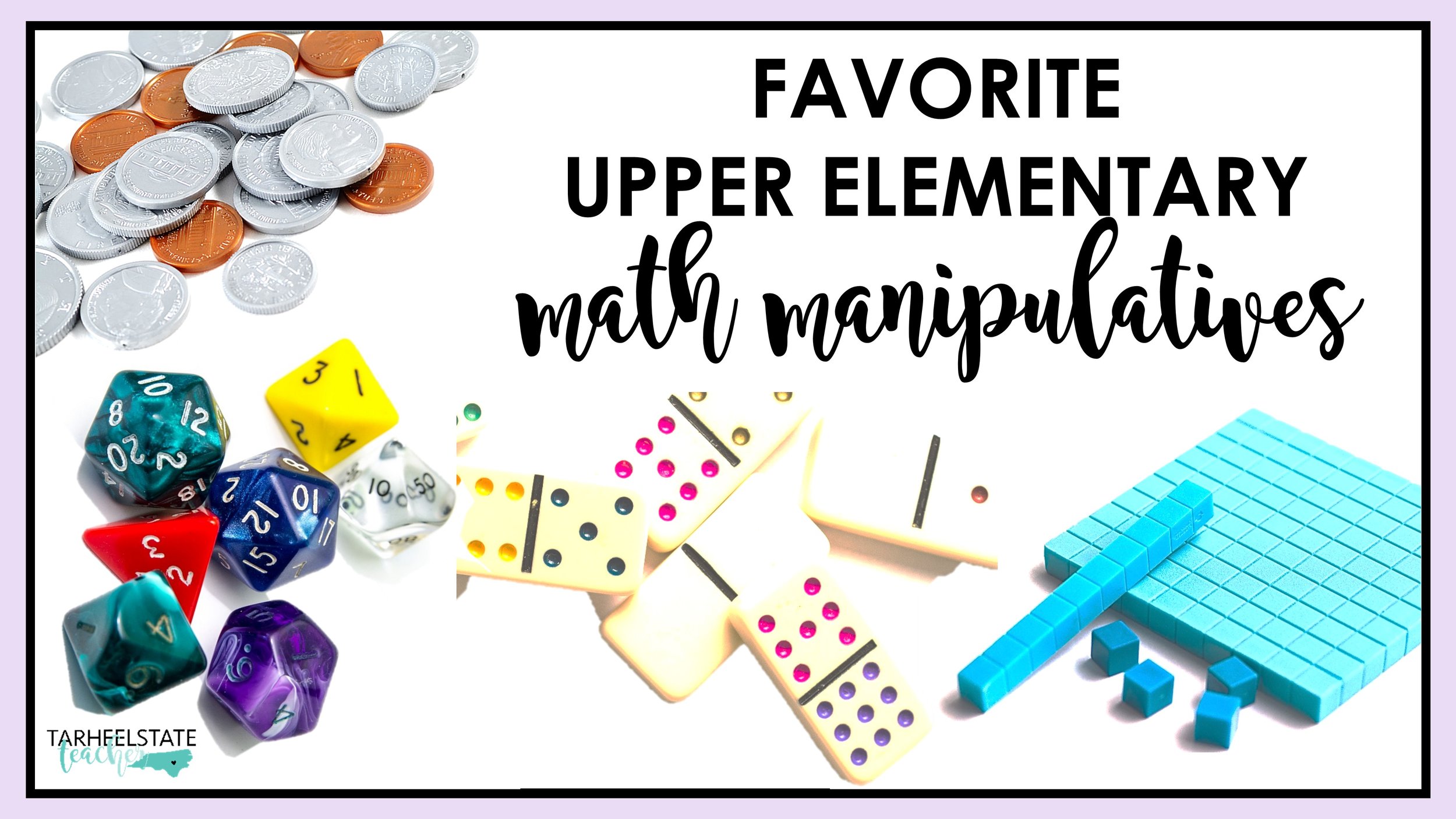
For many of these manipulatives,it wasn't until I had access to a class set that I considered them a "game-changer" for my math pedagogy.
(Doesn't information technology STINK when having access to materials holds you back from doing crawly things in your classroom?!?) With class sets, I plant that I could implement ideas with manipulatives without worrying near having enough materials. I could introduce games and activities during whole grouping instruction and later move them into stations or use them when students finished assignments later in the week.
A few years ago, I was lucky enough to state in a classroom that had access to tons of math manipulatives. Seriously, I spent the entire summertime cleaning out that classroom and organizing #allthethings. For some of the math manipulatives I had available, I was truly unaware of their benefits in a quaternary or 5th grade classroom.
However, having access to these materials (many in quantities great enough for each educatee to accept their own materials) truly opened my mind to many of the ways I could incorporate them into my math lessons.
I keep many of the manipulatives I'm highlighting below bachelor to grab at a second's observe when I'm working with students on different concepts. The more yous employ these manipulatives in your classroom, the more you will find yourself existence prepared for "on the wing" differentiation that helps students "see" concepts versus just showing them once more and again with pencil and paper.
Note: Some of the links in this post are chapter links. This means that I am a participant in the Amazon Services LLC Assembly Plan, an affiliate advertizing program designed to provide a means for sites to earn ad fees by advertising and linking to amazon.com. Read my full disclosure here.
If you lot practice not have access to some of the manipulatives I share in this post, I would really encourage y'all to get class sets of what yous tin beget (beg your principal?!) and at to the lowest degree buy one set up for yourself to play with to design games and activities. Inquire around the school and perhaps you can infringe what you demand for a while.
Let's get to the fun stuff:
RECOMMENDED MATH MANIPULATIVES FOR fourth Form/5th GRADE:
1) Base 10 Blocks


I love having enough base-10 blocks at my disposal for students to employ. I utilize base-ten blocks during whole number operations units (identify value, comparing numbers, adding and subtracting, etc) but I likewise bring them out again during fractions and decimal units. Instead of the 100'southward block being 100, it is now our "whole." Using "x sticks" and ones cubes, students develop better understanding of tenths and hundredths. I've likewise seen lessons using these for multiplication, expanse, and the area model.
Do quaternary or fifth graders really need to "play" with base-10 blocks?
Aye, I remember they do! Ane mode we "played" with base of operations 10 blocks at the starting time of the yr was with our "Place Value Houses" activity.
two) Dice (in many varieties!)
FOR THE Dear OF DICE! Dice come in so many shapes and sizes, I truly did not know all of the diverseness until I came across different ones in my new classroom.


The standard 6-sided die are slap-up for math games, simply 10 sided dice are a game changer for easy differentiation.


I likewise found identify value dice on amazon that have one dice each for "ones, tens, hundreds, thousands, x thousands, hundred thousands, millions, tenths, hundredths, and thousandths.Each die is ten-sided so students can generate every possible number between 0 and 9,999,999.999."
(WOW oh WOW!). Seriously. A grade set up of these are a a game-changer for my place value, expanded form, standard form, comparison numbers, and value of the digits lessons. To differentiate, I tin can just have students who need to showtime small remove the dice for larger numbers and decimals. I just added those to my cart and can't wait to play around with them! BE STILL MY MATH HEART!
Have whatever favorite dice for math of your own? Let me know in the comments!
3) "Play" Money (especially dimes and pennies)


And then, truthful story. When I switched schools, the classroom I took over was total of play money. Dimes, pennies, nickels, all over the identify.
I could non for the LIFE OF ME figure out why a 4th grade classroom had "play" money.
Coin is a lower-grades standard, right?
Well, when we got to our fractions and decimals units, I had students using bags of money A LOT. This is one of the {very important} manipulatives that I would proceed close past during my decimal lessons.
When students fabricated mistakes like "i/100 > 1/x," I would bring them a bag of money and ask them, "Which coin is 1/100 of a dollar? Which coin is 1/10 of a dollar? Which coin has a greater value?"
When students compared decimals (.08 compared to .3) and chose the wrong number, I'd have them stand for each decimal with money, discuss the value of the monetary representation, then explicate how they knew which decimal number was larger. By bringing out the coin, I was able to continuously address misconceptions and help students develop their concept of decimals. This, combined with our classroom lessons continuously reinforced their understanding of decimals.
4) Fraction Manipulative Sets


Okay, I've already shared that I was lucky at my school, merely in this case, I felt SUPER spoiled. I was able to request a CLASS SET of plastic fraction circles. The realllly good fraction set is the ane that has a plastic container to put the pieces in. These were in short supply when I purchased mine, then I had to supplement with the fraction sets that only come up in a plastic bag.
(I've read some research about having students create their own representations of fractions with paper, and I'1000 non going to debate the value of that, just I will say, no one tin really contest the benefits of having ready-made fraction manipulatives that students are able to become their hands on once again and again to bring fraction concepts to life during math lessons. Manipulatives in the hands of a skilful teacher are never bad, in my opinion. And, set made fractions manipulatives are meliorate than using NO manipulatives at all, seriously.)
Aye—in fourth grade and 5th class, students yet demand to touch fractions!
With my 4th graders, nearly every lesson at the get-go of our fractions unit of measurement started with me prompting them to do something with their fractions sets. I recommend giving each student a ziploc bag, having them write their proper noun on it, and giving them the same fix of fractions manipulatives each fourth dimension you use them. This way, a students' messy manipulatives are their mess; if they lose pieces (cringe), they accept to be the one to deal with not having what they demand.
Some examples of fractions prompts I've used include:
-
create all of the equivalent fractions yous tin (students ofttimes eye-brawl these; yous tin accept discussions about whether or not the fractions are equivalent or "close" in size. In later lessons, employ mathematical operations and proof to make up one's mind if the fractions are equivalent)
-
make one whole all the means you are able to
-
find all the ways you can make 1/ii (3/4, ii/3, etc).
-
model equations that equal 7/8 as many means as you lot can using merely eighths (to piece of work on decomposing fractions)
-
using fraction models and words, explain why two/3 + 2/three ≠ four/half-dozen
Notation: I prompt with these directions on the smart board and students record their answers in their math journals.
5) Decks of Playing Cards
Decks of playing cards tin can be used for so many math activities! The range of digits from 1-ten (making an Ace a one) make them perfect for identify value lessons, comparing whole numbers, multiplication or sectionalization war, and more than! Y'all can remove the face cards or make them "wild cards" where students tin choose the number they'd similar to apply. Whip up a quick playing mat OR let students depict on their desks with Expo markers for fifty-fifty more excitement.
Playing cards would be a PERFECT thing to add to your back to school supply list to easily get your form sets, or grab them at the dollar store (if y'all are Blazon A and would desire all of them to be of the same quality!) I'm game for shopping around and finding 25 different and Beautiful decks of cards so that we can keep them all separate.
One of my nearly favorite means to incorporate playing cards into my fractions unit was when we played a comparing fractions menu game. As we were playing, I figured out different ways to scaffold and aid my students increasingly develop their power to compare more challenging fractions. (You can check out all the rounds I used for the game in this blog post.)
half dozen) Dominoes


I haven't incorporated dominoes a lot into my math activities, but THEY Expect Like FRACTIONS, so what am I waiting for?
Peradventure it's because I've never had a class set of dominoes, but I want to take hold of some so that I can play around and come up up with new ideas. This domino fix looks awesome. Information technology contains xv sets in 6 different colors. This is another particular you can grab at the dollar store besides! And don't even become me started on the domino sets designed specifically for math activities-- fraction dominoes, polygon dominoes (I have something similar to this)! Students can even make their ain Domino activities! The possibilities are countless!
Have y'all read this post and withal feel unsure of how to really use math manipulatives in your math classroom?
I didn't requite you a ton of ideas in this blog post...I am but getting started and program to share more ideas for using these math manipulatives for different concepts...
but, MY ADVICE:Don't await until you lot "know" how you will employ these math manipulatives to get your hands on them. Start collecting and buying to build yourself class sets of these tools for math (if you are not lucky enough to have them given to you lot or purchased by your school).
—> Many of the ways I figured out to use these manipulatives in my lessons only happened because I had Access to them.
Pinterest is besides a nifty tool to use when trying to come upwardly with ideas! Search for ideas on the topics yous are covering and I just know you will observe some way to engage your students in a more hands-on math block!
I've created a list of some of these favorite math manipulatives on amazon! You tin check out all of my recommendations past clicking hither!
I know there are other math manipulatives that some teachers would consider crucial, but these are my favorite 6. What other manipulatives should I add to my upper elementary toolbox?
Want more than helpful math stations tips? Check out these posts about Math Stations:
⇒ An Overview of My Upper Elementary Math Stations
⇒ v Rules for Math Stations...that y'all can break!
⇒ Math Station Essentials {Tools for Organization and Direction}
⇒ Organizing Your Math Stations Schedule: Math Stations Rotation Template
hopwoodtheakision.blogspot.com
Source: https://www.tarheelstateteacher.com/blog/must-have-math-manipulatives-for-upper
Belum ada Komentar untuk "Reading Manipulatives in an Upper Elementary Classroom"
Posting Komentar